Credit Review Routing
System-managed assignment and review coordination in multifamily real estate credit approval
ROLE
Senior UX/Product Designer Concept & Prototype
FOCUS
Assignment logic, Workflow orchestration, Operational visibility
DOMAIN
Multifamily underwriting Credit review & approval workflows
TOOLS
Prototype: React, Material UI, Vite Architecture: FigJam
SUMMARY
Replaced manual, email-based assignment with system-driven reviewer routing
Introduced capacity- and availability-aware assignment logic aligned to approval authority
Unified assignment, review, and decision capture within a single workflow
Preserved borrower context by routing repeat deals to familiar reviewers
Built a high-fidelity prototype to validate workflow logic and operational feasibility
OVERVIEW
This project presents a credit review pipeline that coordinates deal assignment and oversight within a multifamily real estate loan lifecycle.
In the existing process, reviewer assignment is handled manually through email and informal coordination. Decisions depend on reviewer authority, workload, and availability—information that is not consistently visible or system-managed—resulting in unclear ownership and uneven distribution of work.
The system assumes responsibility for assignment. When a deal is submitted for review, it evaluates policy requirements and operational constraints to assign the appropriate reviewer automatically.
Deals enter the pipeline already assigned, enabling immediate ownership. The interface provides visibility into individual and team workload, while allowing team leaders to rebalance assignments when needed.
This prototype focuses on the intake, routing, and oversight layer of the workflow. Detailed credit analysis and approval are represented as downstream systems.
EXISTING WORKFLOW
Manual Assignment & Fragmented Coordination
Insights were gathered through nine 45-minute interviews with credit reviewers across levels, focusing on assignment practices and coordination challenges.
In the current workflow, deals are submitted for review and distributed via email as full PDF packages. Reviewer assignment is determined informally, with team members coordinating ownership through email or chat.
Review work is conducted outside the system. Reviewers send decisions back to the underwriter, who records the outcome.
This results in:
Ambiguous or shifting ownership
Delays during assignment and reassignment
Uneven workload distribution
Decisions recorded indirectly rather than at the source
Increased coordination overhead, especially under time constraints or when reviewers are unavailable
The limitation is not reviewer expertise, but the absence of a system that structures assignment and review. Without shared visibility and a common workspace, the process remains manual, fragmented, and difficult to scale.
Legacy Deal Review Assignment Workflow
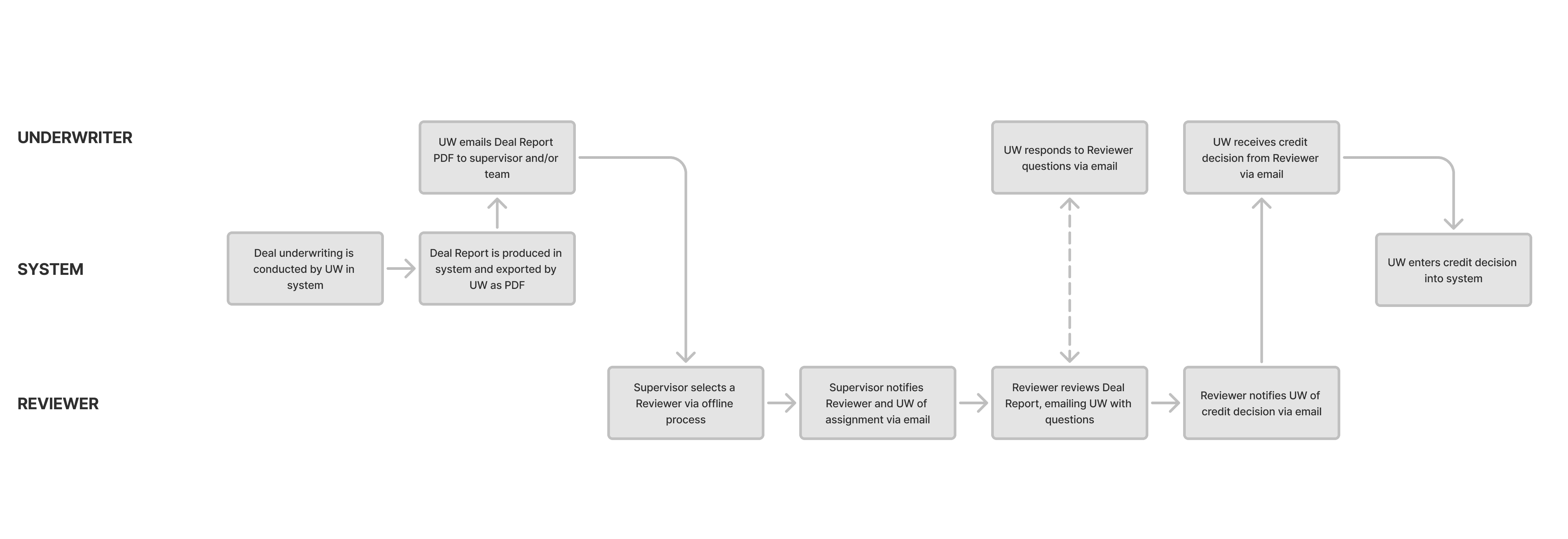
Assignment, review, and decision capture are distributed across email and offline processes, resulting in fragmented ownership and reliance on manual coordination.
SYSTEM REDESIGN
Automated Assignment & Integrated Review Workflow
The redesigned system unifies assignment, execution, and decision capture within a single workflow.
When a deal is submitted for review, the system evaluates policy requirements and operational constraints to assign the appropriate reviewer. Assignment is automatic and aligned to policy and operational constraints.
Every deal is assigned at submission and retains a single owner through review. Assignment is system-driven but not rigid—team leads can reassign work when needed.
Credit review moves into the system. Reviewers access deal information, conduct analysis, and record decisions within the same environment used by underwriters.
End-to-End Workflow Within a Single System
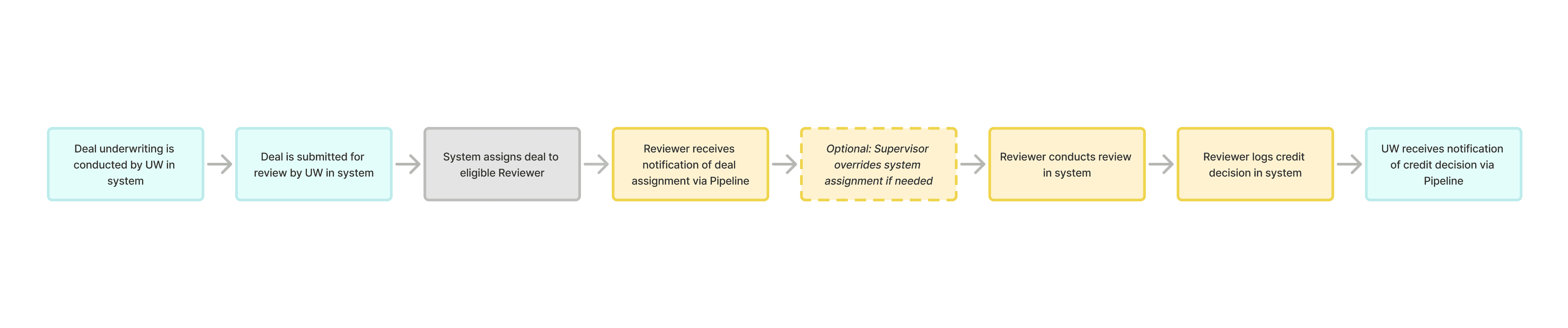
Assignment, review, and decision capture occur within the same workflow. Deals are assigned, reviewed, and resolved without leaving the pipeline. Overrides are supported without disrupting the workflow. Ownership persists from submission through decision, with outcomes recorded at the source.
PROTOTYPE
Pipeline Interface & Interaction Model
This high-fidelity prototype implements a system-managed credit review pipeline within a multifamily underwriting workflow. It demonstrates automated assignment, in-system review, and team-level oversight through a unified interface.
Deal Pipeline
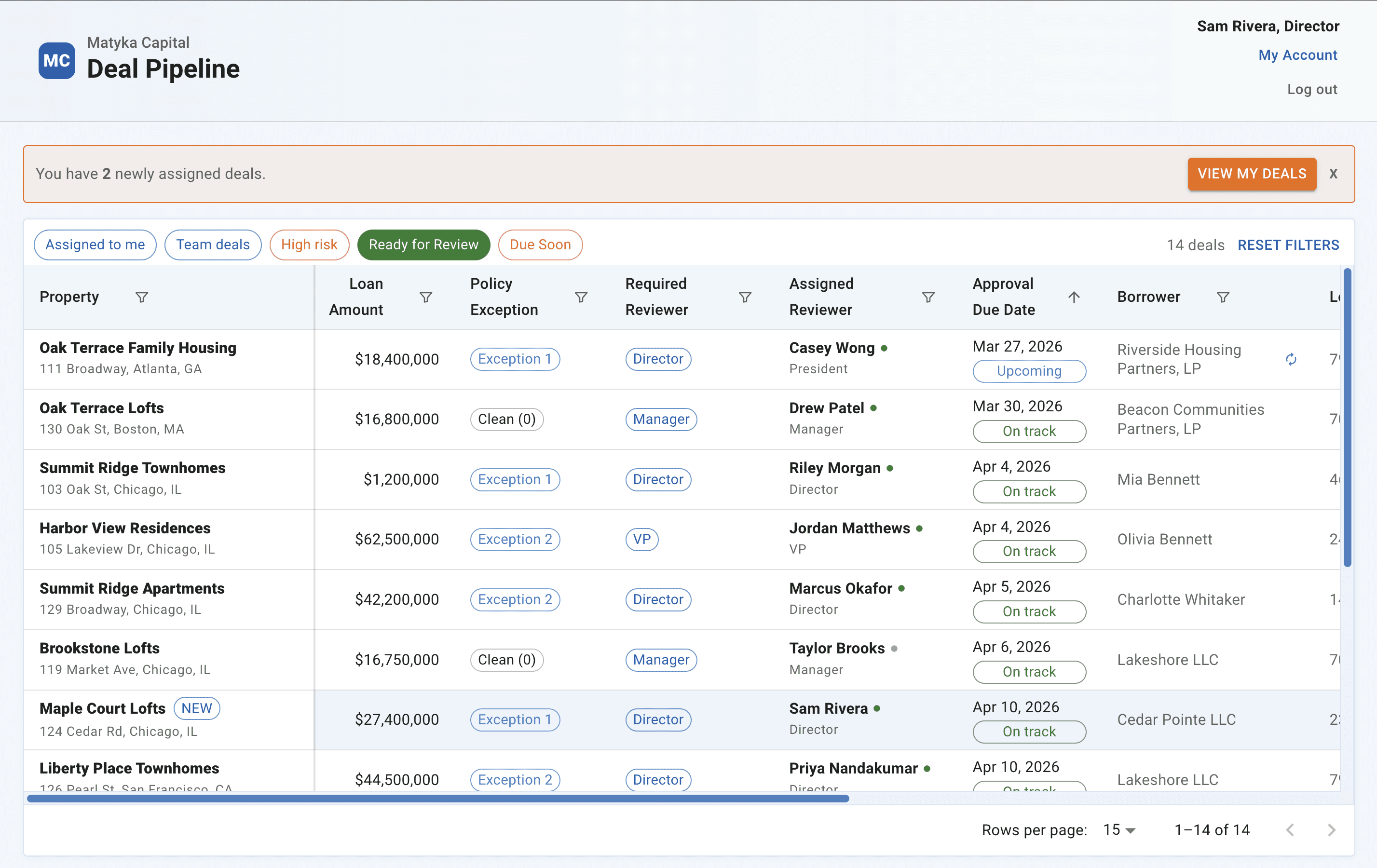
The primary pipeline surface shows all active deals with assignment, required approval level, and review status. Deals are assigned at submission, enabling immediate ownership and prioritization.
Deal Context Drawer
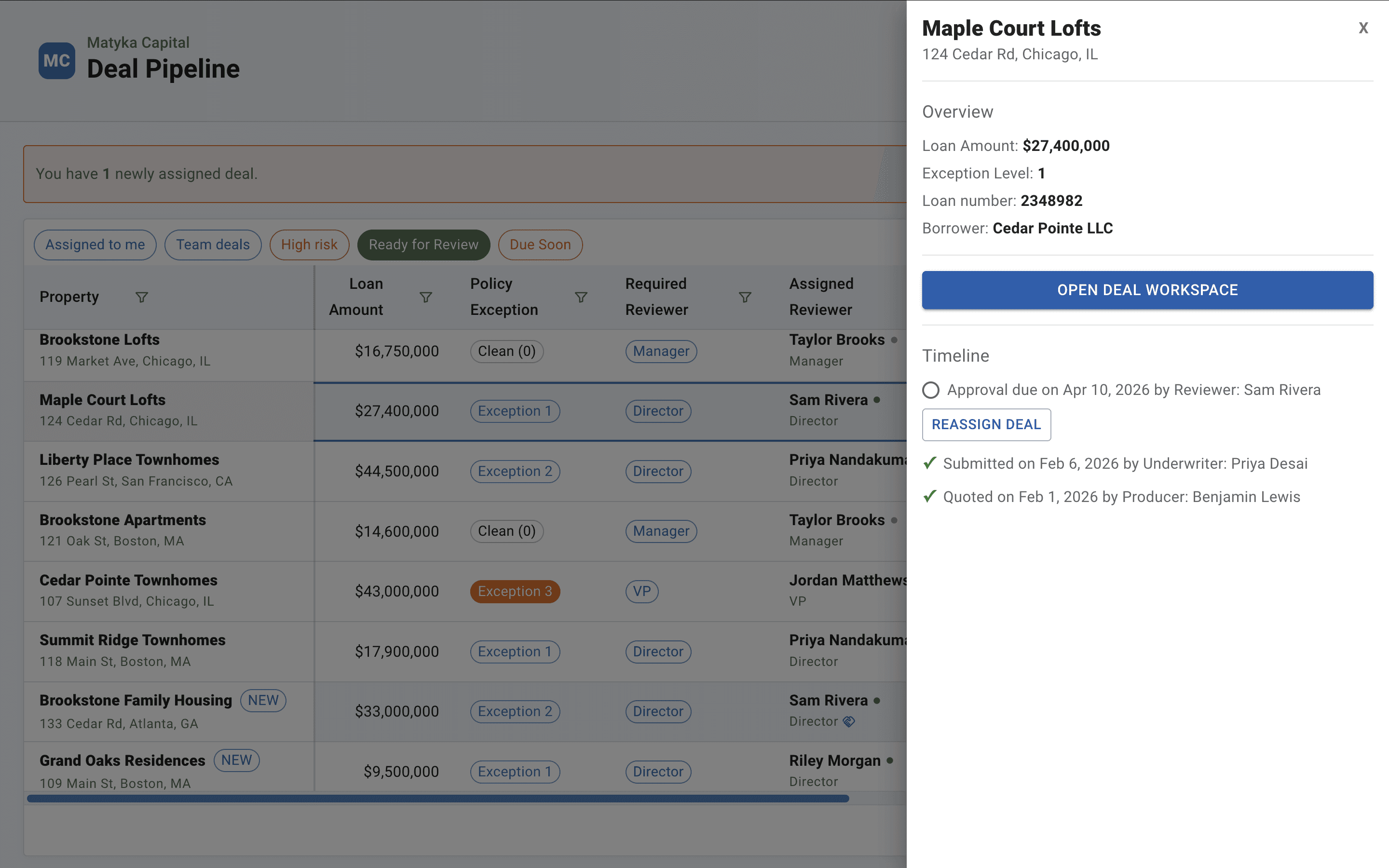
Opening a deal reveals status, timeline, and key context while preserving the pipeline view.
Reassignment Interaction
STEP 1
Realtime notification
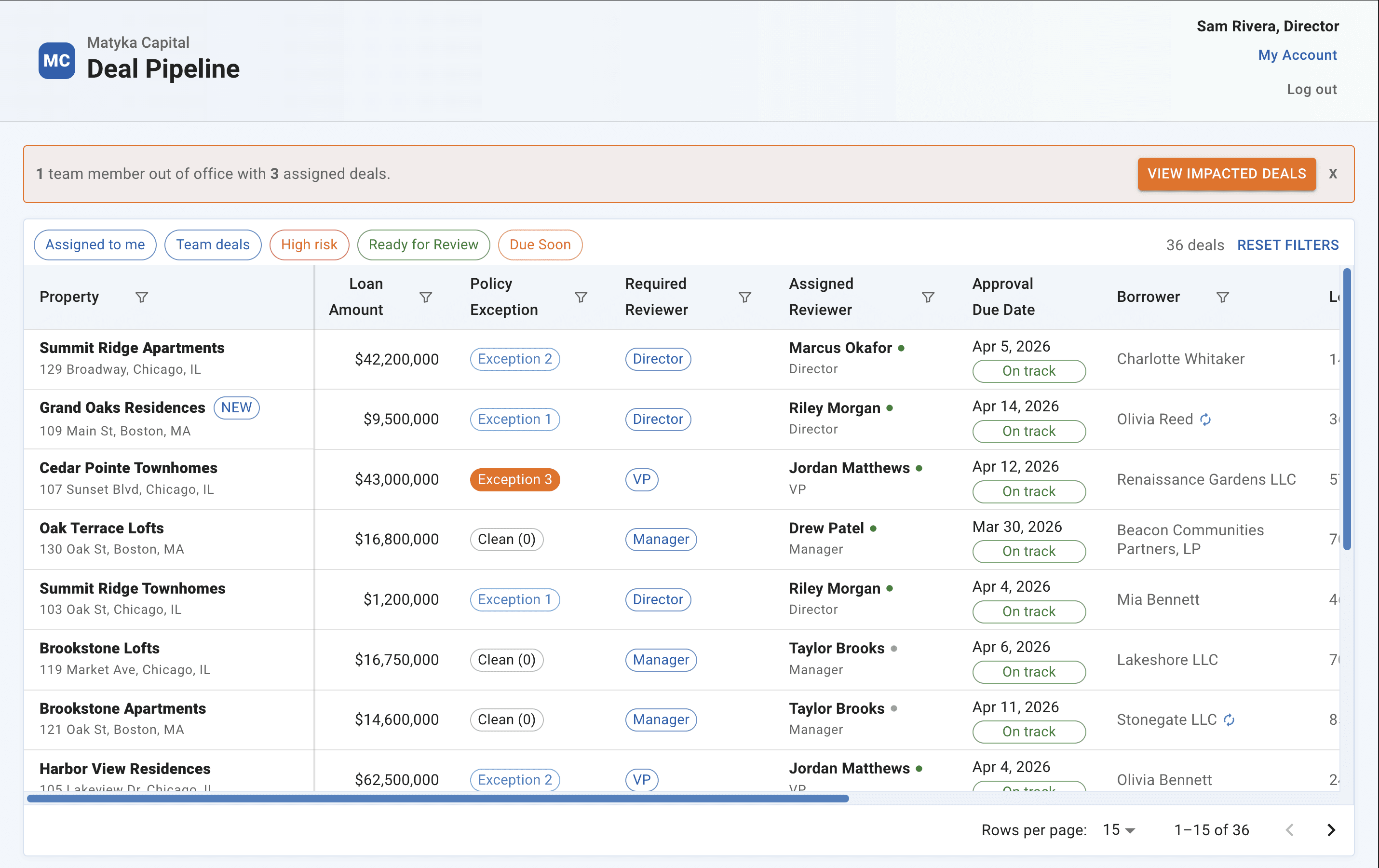
A notification alerts the supervisor to a team member's absence. The pipeline supports team-level oversight, allowing users to respond quickly to dynamic conditions.
STEP 2
Pipeline filtering
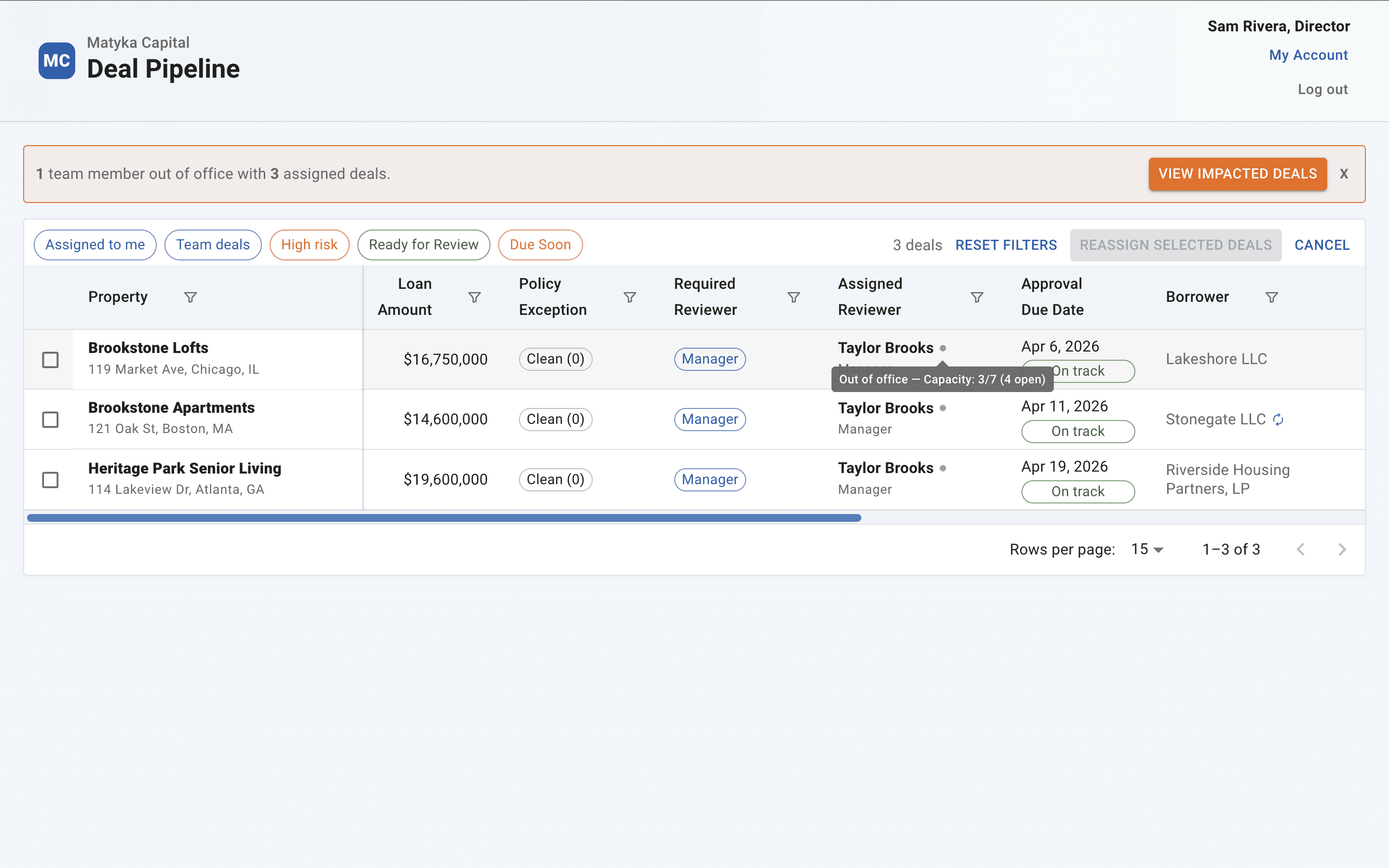
Row-level signals indicate ownership and capacity, making workload changes visible without manual tracking.
STEP 3
Deal selection
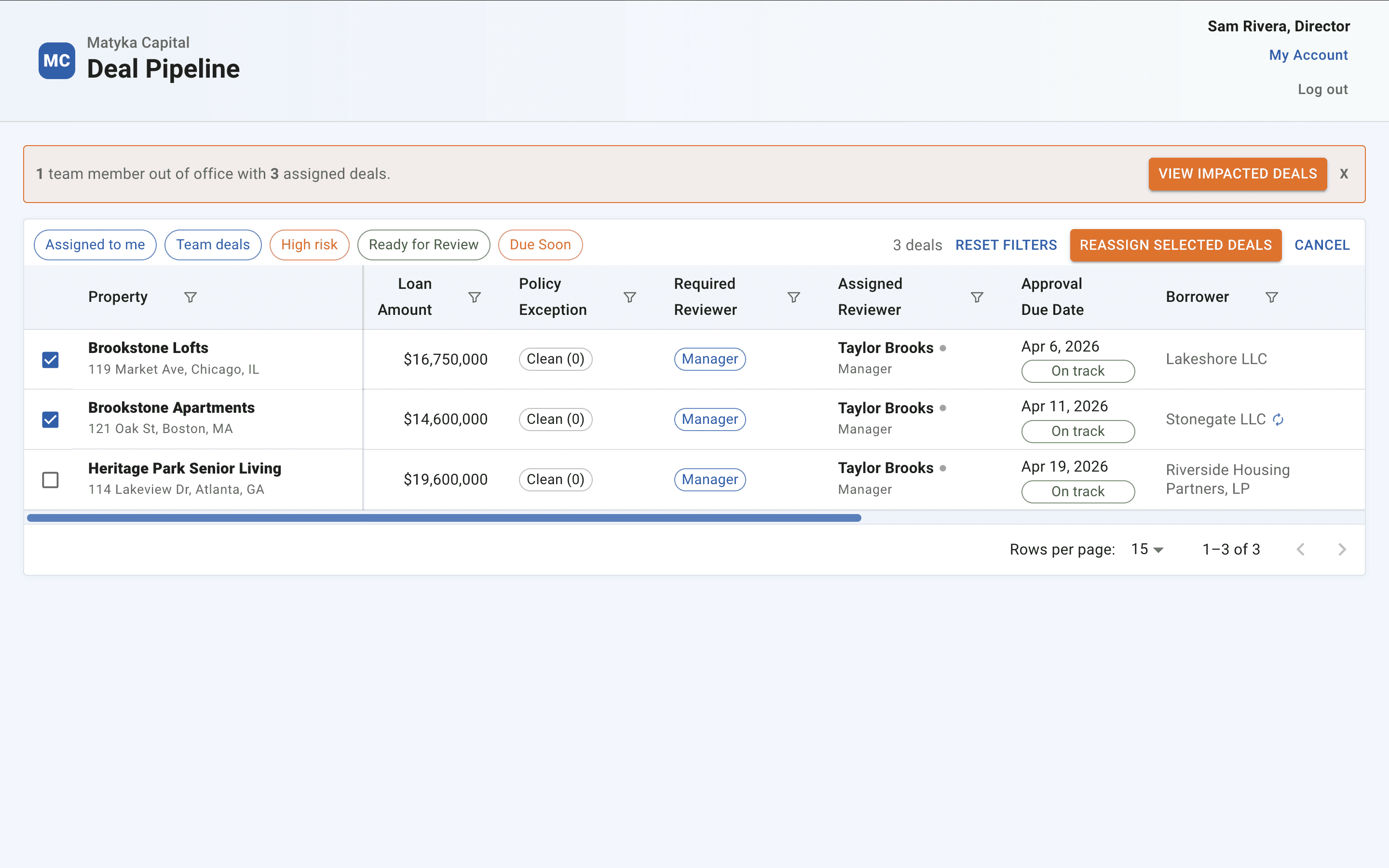
Inline deadlines inform assignment decisions and support proactive workload management.
STEP 4
Automated reassignment
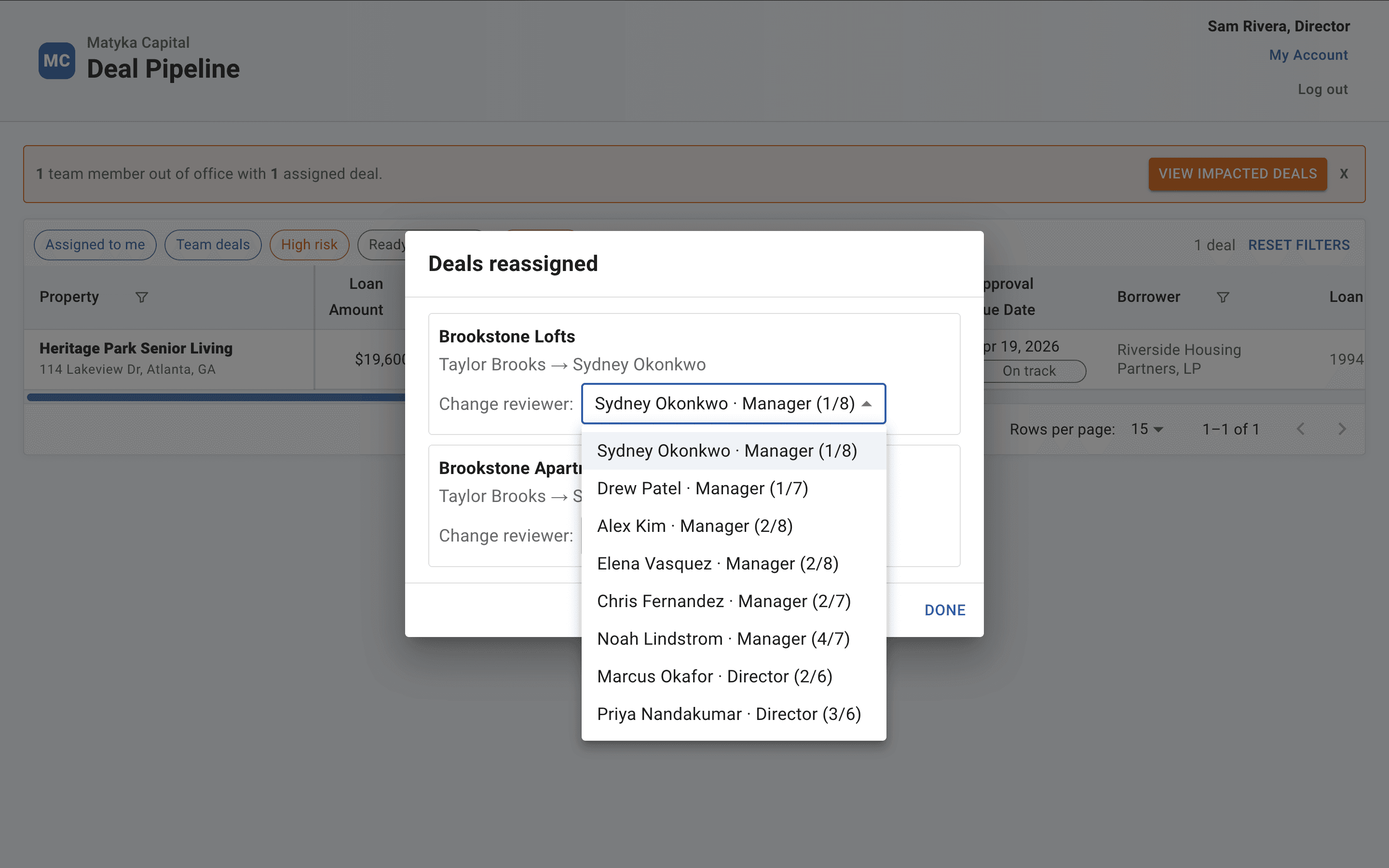
Reassignments can be adjusted through lightweight controls. The system enforces eligibility while allowing managers to override when needed.
SYSTEM MODELING
Key Design Decisions
The prototype reflects modeling decisions that define how credit review assignment operates within a structured, policy-driven system.
1. Assignment is system-owned
Assignment occurs automatically at submission
Manual assignment is reserved for exceptions
2. Authority is policy-derived
Required level is derived from loan amount and exception rating
Only eligible reviewers are considered
3. Assignment is capacity-aware
Capacity and availability inform assignment decisions
Borrower familiarity can influence reviewer selection
4. Ownership is continuous
Every deal has a single assigned reviewer
Ownership persists through decision
5. Review occurs within the workflow
Reviewers access and evaluate deals directly
Decisions are recorded at the source
6. Override is supported but constrained
Team leads can reassign deals when needed
Eligibility constraints remain enforced
7. Logic is not exposed in the interface
Users see assignment outcomes, not rules or scoring
Complexity is handled by the system
Logic Model for Deterministic Assignment
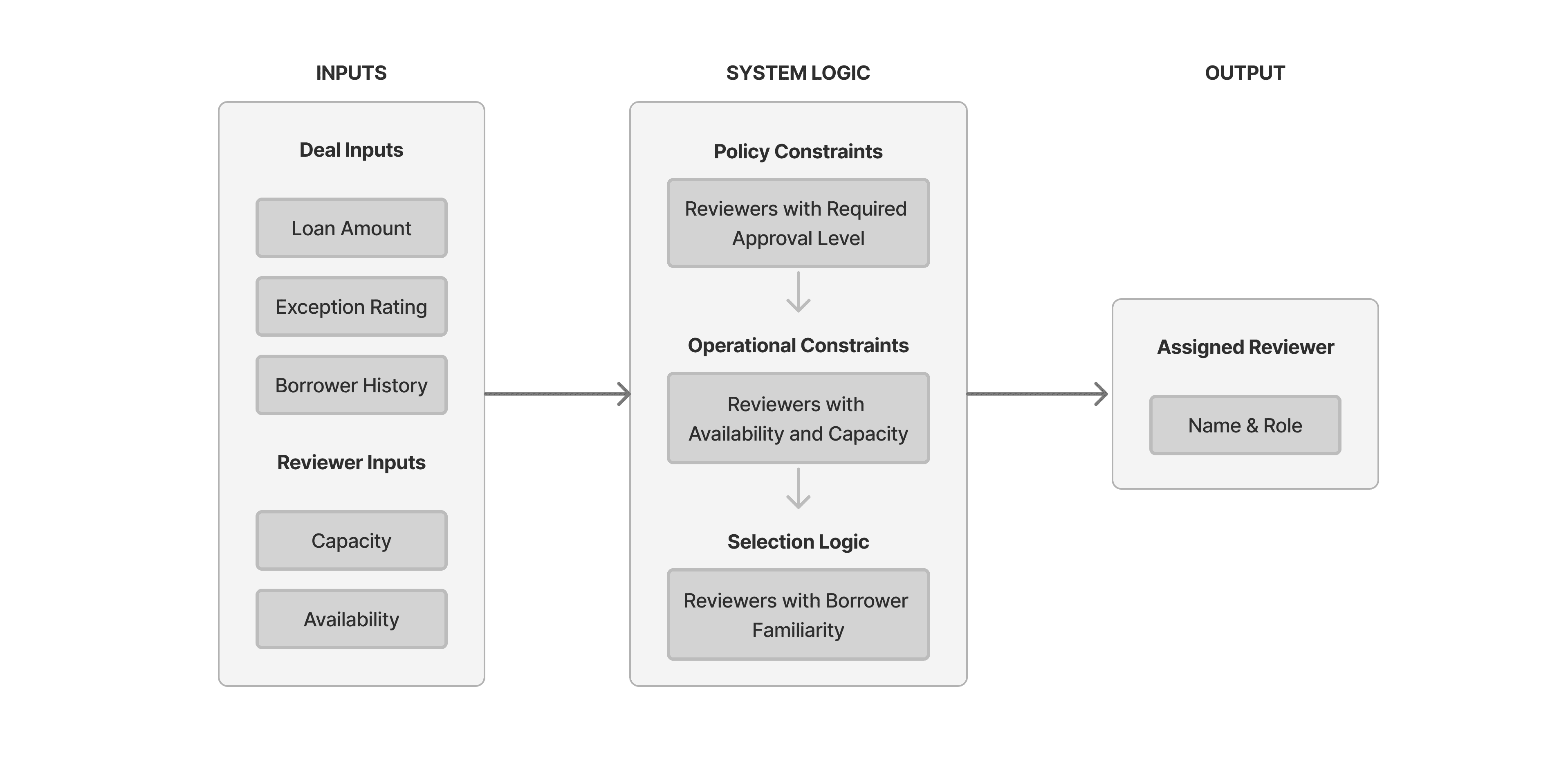
Assignment is determined by combining policy requirements with real-time operational constraints, producing a single eligible reviewer at submission.
OUTCOMES
Operational Impact
Structured Assignment, Clear Ownership, and Reduced Coordination Overhead
The redesigned pipeline shifts credit review from a manually coordinated process to a system-managed workflow, improving consistency, visibility, and operational clarity.
Work is assigned immediately, without coordination
Reviewers receive deals already assigned at submission, with eligibility enforced based on policy thresholds. This removes delays and variability introduced by manual coordination.
Ownership is clear from the start
Each reviewer is responsible for a defined set of deals, maintaining ownership through decision and eliminating ambiguity during the review process.
Review happens where the work lives
Reviewers evaluate deals and record decisions directly, ensuring that system state reflects actual progress rather than relayed updates.
Prior borrower context carries forward
Reviewers can be matched to repeat borrowers they have previously evaluated, allowing decisions to build on prior knowledge rather than restarting analysis.
Workload is visible and easier to balance
Team leaders can see workload distribution across reviewers, using capacity and availability to identify imbalances and rebalance work as needed.
Less time is spent coordinating work
Underwriters and reviewers no longer rely on back-and-forth communication to assign or track work, reducing friction during tight timelines or staffing changes.
Flexibility remains when conditions change
Team leads can override assignments when needed, using lightweight controls that maintain system constraints without reverting to manual workflows.
DESIGN CAPABILITIES
What This Work Demonstrates
This work demonstrates how policy and operational constraints translate into structured, system-driven workflows.
Designing system-driven workflows that replace manual coordination
Translating policy rules into enforceable system logic
Modeling operational constraints (capacity, availability, coverage) within product behavior
Balancing automation with human override in high-stakes environments
Designing for clear ownership and accountability across multi-step workflows
Creating data-dense interfaces that support both execution and oversight
Building high-fidelity prototypes that simulate real-world system behavior using deterministic data