Reputation Risk Screening
Enterprise workflow redesign for multifamily underwriting compliance screening.
ROLE
Senior UX/Product Designer Concept & Prototype
FOCUS
System orchestration, institutional memory, auditability
DOMAIN
Multifamily underwriting Reputation risk
TOOLS
Prototype: React, Material UI, Vite Architecture: FigJam
SUMMARY
Redesigned a manual borrower reputation screening workflow used in multifamily underwriting
Replaced repeated, deal-bound screening with entity-level persistence and reusable findings
Shifted screening from user-coordinated searches to a centralized, system-managed process
Separated automated screening from analyst risk evaluation to strengthen audit defensibility
Built a high-fidelity React prototype to validate workflow logic and feasibility
OVERVIEW
This project presents a redesign of a manual borrower reputation screening workflow used in multifamily loan underwriting. In the legacy process, underwriters coordinated searches across external tools without persistent system memory, resulting in repeated screening of the same entities across deals.
The redesigned architecture shifts screening from user-driven coordination to centralized system orchestration. Screening results are stored at the entity level, maintaining consistent identity across deals allowing prior findings to be reused without compromising traceability.
The solution separates automated screening state from analyst evaluation, preserving human judgment while strengthening audit defensibility. To validate workflow logic and entity-state modeling, I built a high-fidelity React prototype.
EXISTING WORKFLOW
Manual Screening - Legacy State
Insights were informed by a cross-functional focus group of underwriters from analyst to director level.
The core limitation of the existing workflow was not interface complexity but the absence of system-level orchestration. Screening was driven by individual users navigating between external search tools and internal documentation systems.
For each entity in a deal, underwriters manually executed searches across Google and LexisNexis and recorded findings in the internal platform. Because prior results were not surfaced automatically, screening efforts were routinely duplicated, particularly for repeat borrowers.
Without automated queries or institutional memory, each deal effectively reset the process. Risk evaluation was subordinated to manual coordination and documentation.
Manual Screening Workflow
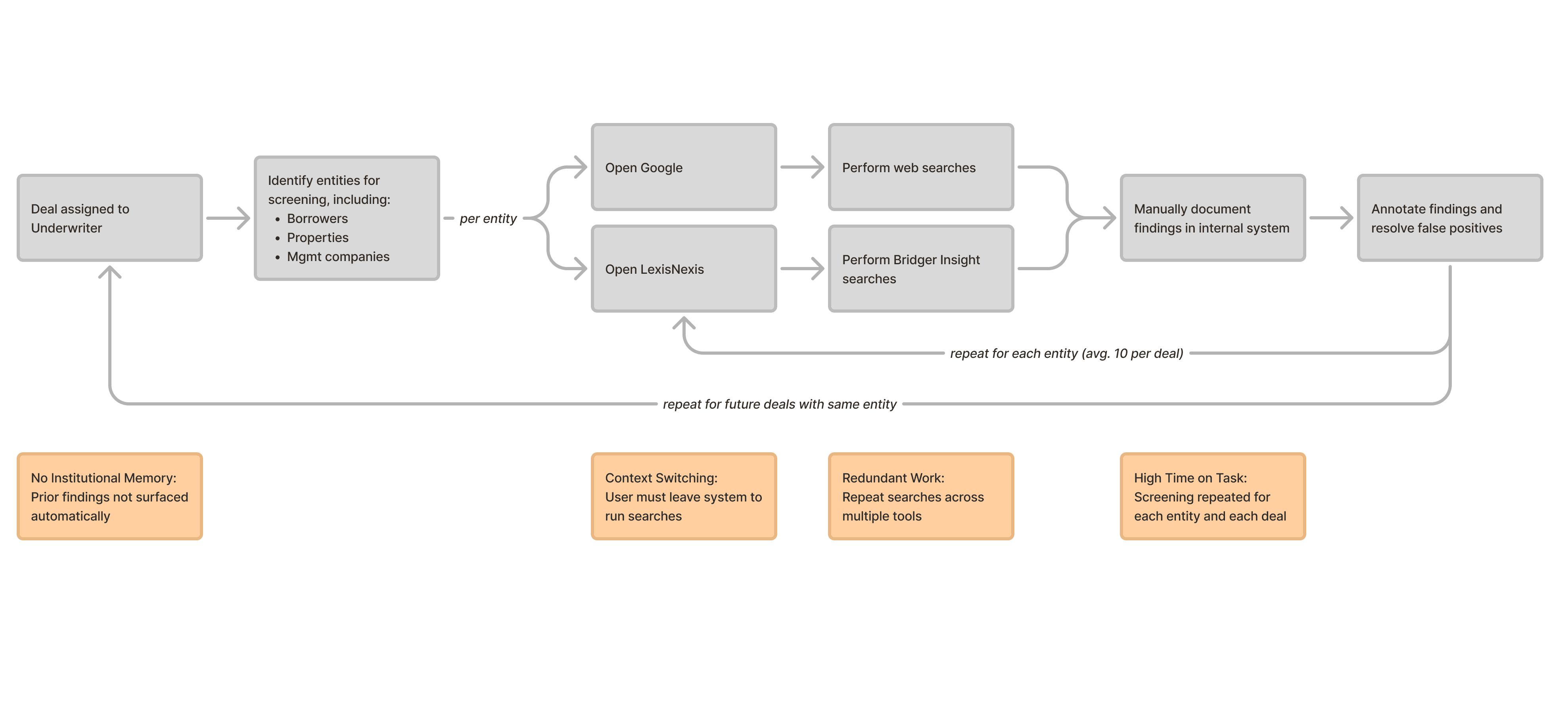
The legacy workflow shows how underwriters manually ran searches, documented findings, and repeated screening work across deals without system memory.
SYSTEM REDESIGN
Screening Orchestration & Institutional Memory
The redesigned architecture moves screening from a manually coordinated process to a system-managed workflow. Borrower intake data is structured into normalized entities, allowing the system to run external searches and retrieve prior findings from a centralized repository.
The system executes queries automatically, stores findings at the entity level, and surfaces prior results when the same entity appears again. Screening outputs are generated within the platform and prepared for analyst and credit review.
By bringing intake, search coordination, persistence, and output generation into a single system, screening becomes a repeatable, scalable capability rather than a manual task.
Screening System Architecture
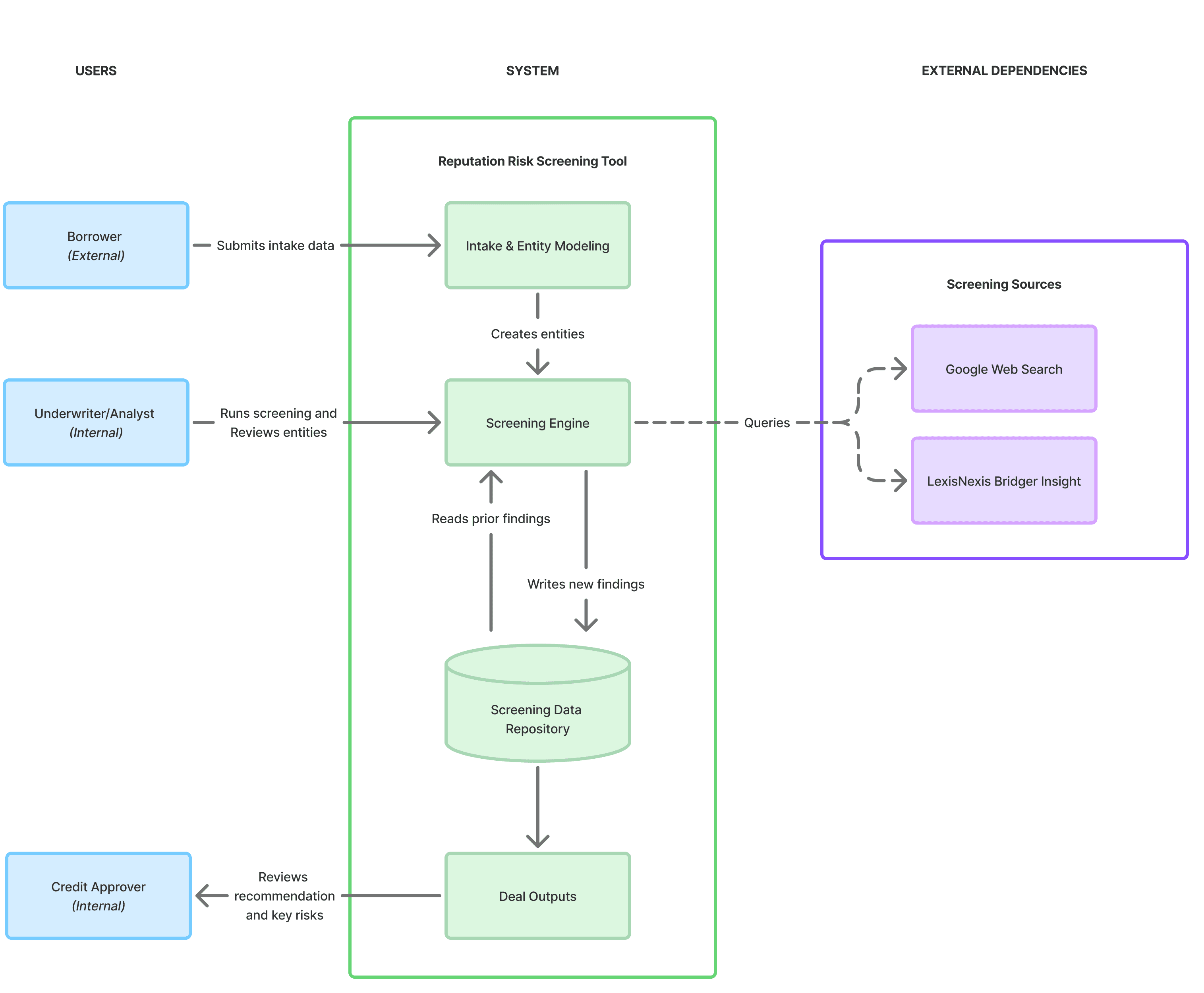
The redesigned architecture shows how intake data moves through the screening system, connects to external sources, stores findings, and generates outputs for underwriting review.
PROTOTYPE
Screening Interface & Interaction Model
This high-fidelity React prototype implements entity-level screening and dynamic risk logic within a multifamily underwriting workflow. It enables structured review, centralized screening, and reuse of prior findings across deals.
Entity-level screening workspace
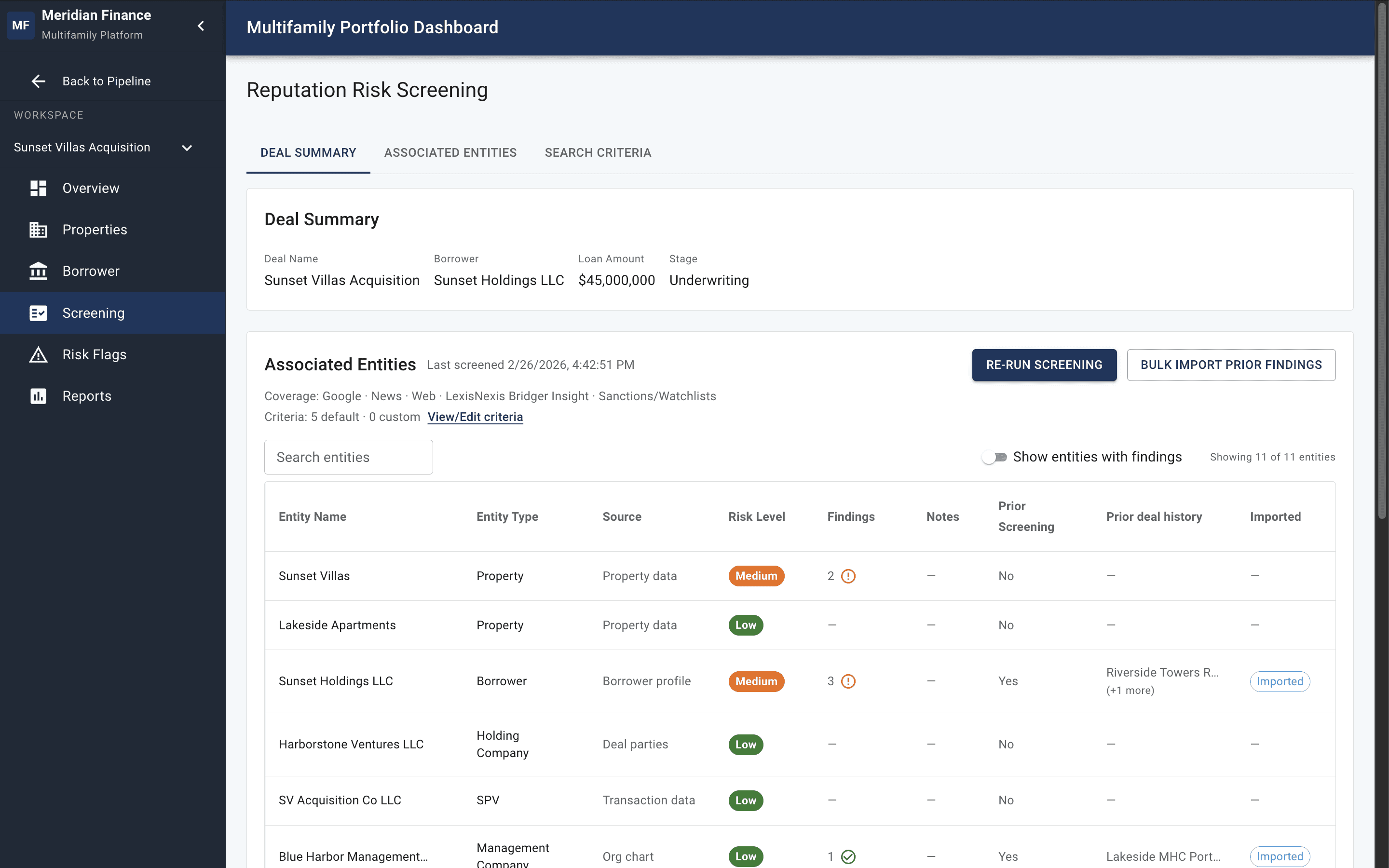
The main screening workspace shows entity-level risk, findings counts, prior screening history, and controls for re-running or importing results
Evidence-based Review Workflow
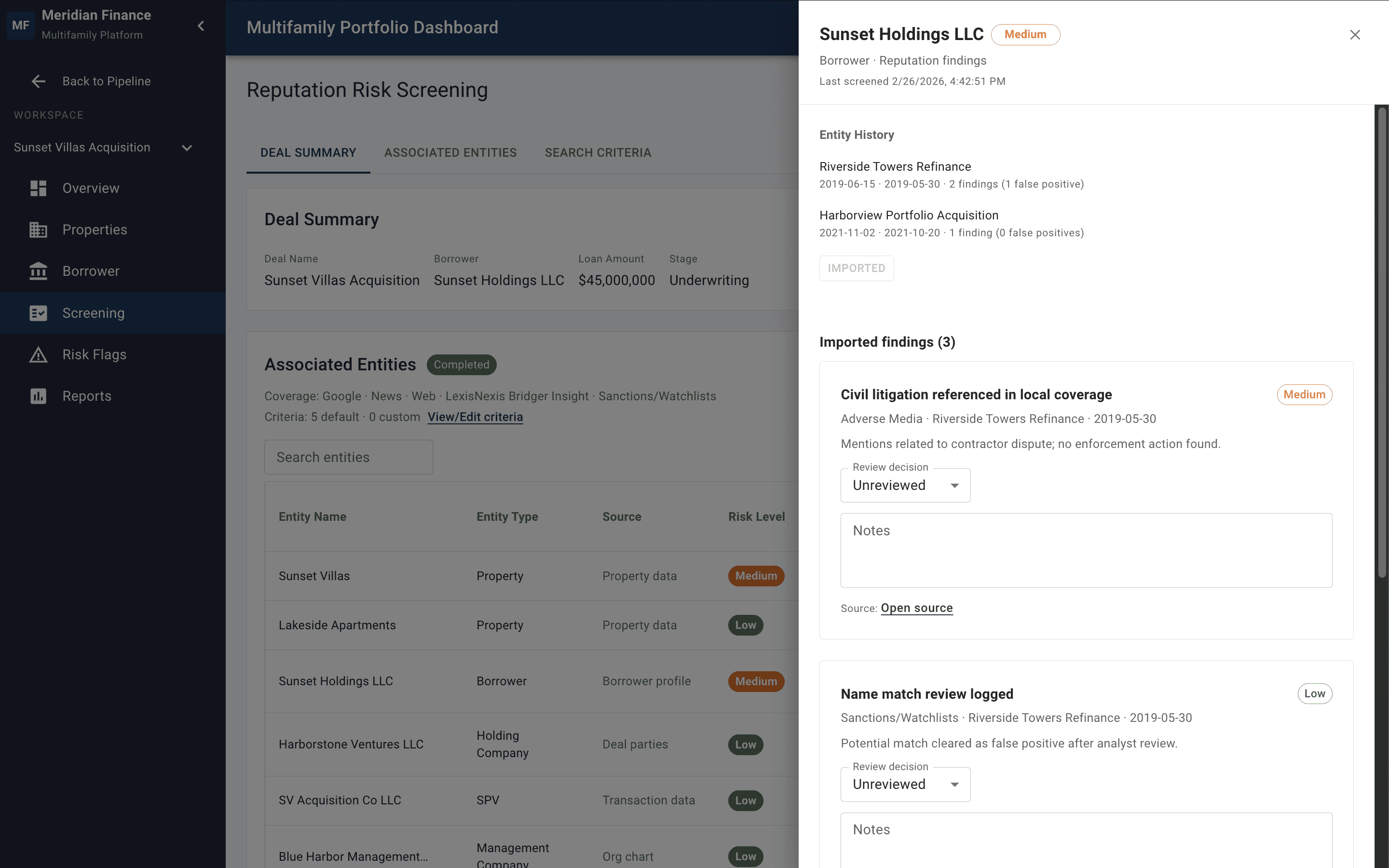
Opening an entity reveals source-level findings, severity, review decisions, and notes that directly influence derived risk
SYSTEM MODELING
Key Design Decisions
The prototype reflects a set of deliberate modeling decisions about how screening should function in a regulated underwriting environment. These decisions prioritize audit defensibility, rules-based state logic, and institutional memory over automation shortcuts.
1. Separate Screening Execution from Analyst Evaluation
Screening execution and human review are modeled as distinct states
The system runs queries and generates findings
Analysts review and classify findings as Confirmed or False Positive
Review status is derived from interaction, not manually toggled
This separation preserves audit traceability and prevents ambiguity between “search complete” and “risk resolved.”
2. Model Institutional Memory at the Entity Level
Risk belongs to entities, not deals
Findings are stored at the entity level
Prior results can be imported deterministically
Identity remains consistent across transactions
This enables reuse without compromising traceability or source attribution.
3. Risk Is Derived from Evidence
Risk is not assigned manually. It is computed from material findings
Final risk reflects the highest-severity confirmed finding
Imported findings surface prior risk context, while the final risk level reflects the current screening run and confirmed findings
False positives dynamically reduce calculated risk
Risk updates as findings are introduced or reclassified. This ensures that risk remains attributable to specific evidence rather than functioning as a static status indicator.
Dynamic Risk Recalculation After Review
STEP 1
Screening Result
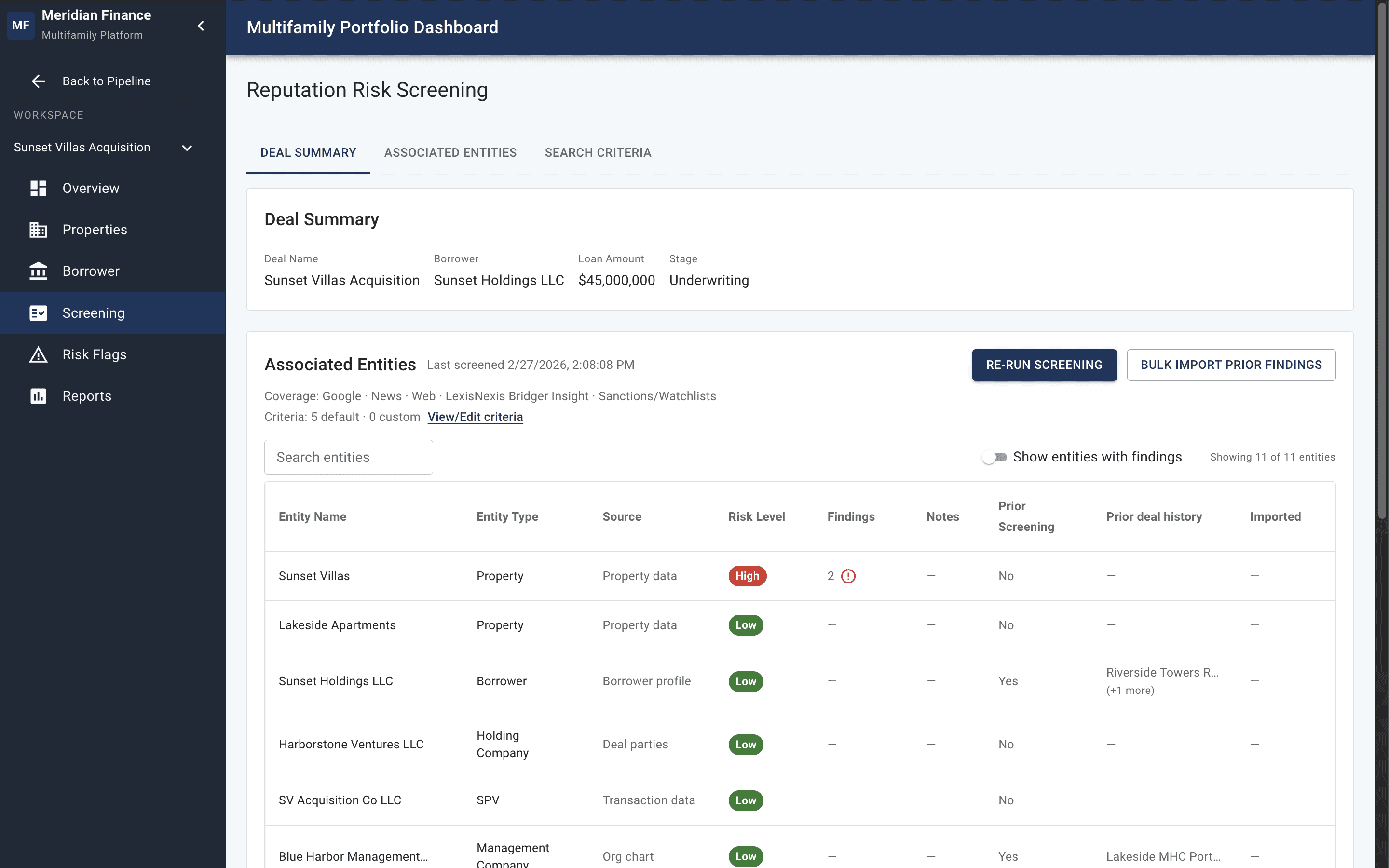
The initial screening returns a high-severity finding.
STEP 2
Analyst Review
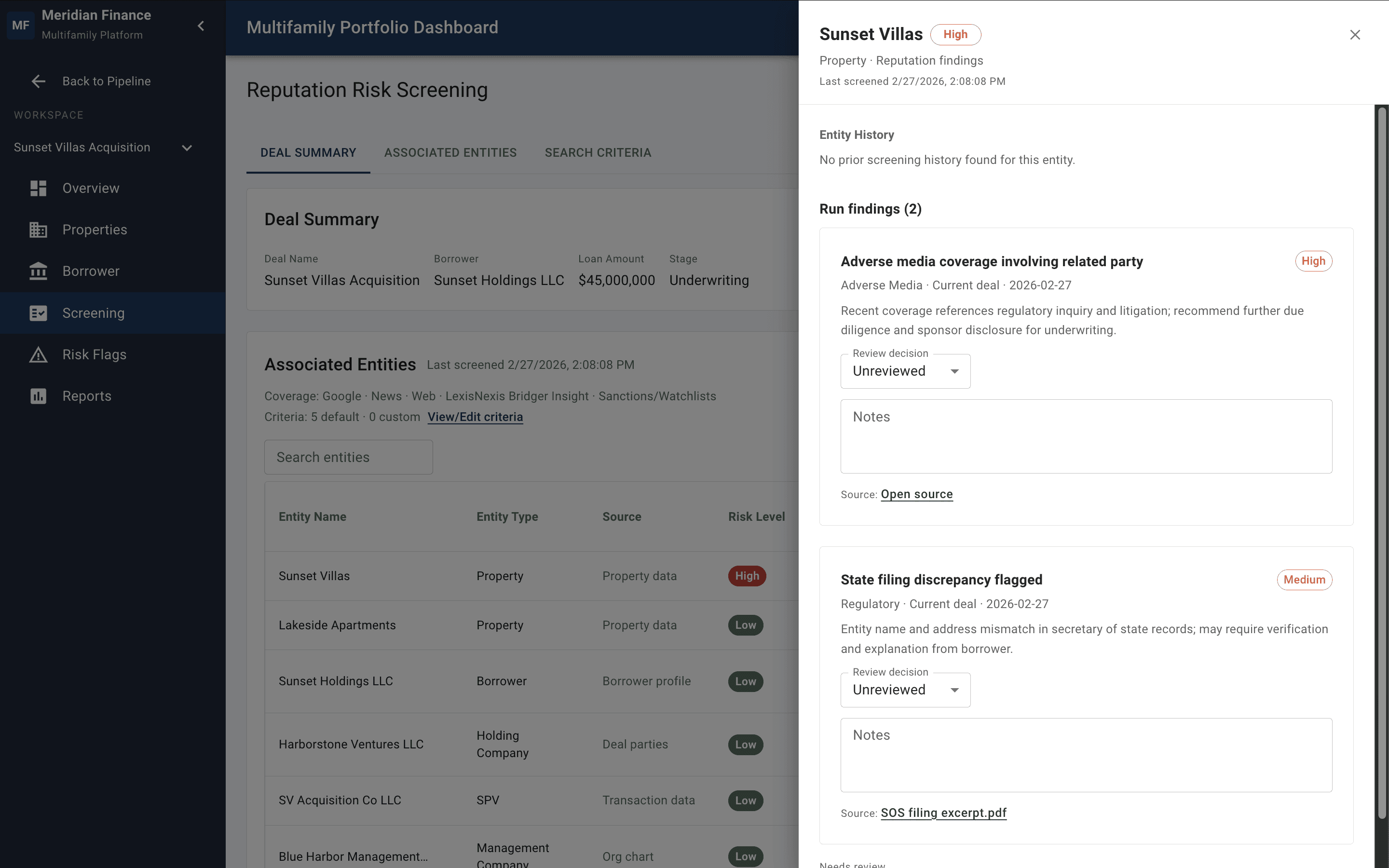
The analyst reviews the finding, examines source evidence, and determines whether it is material or a false positive.
STEP 3
False Positive Determination
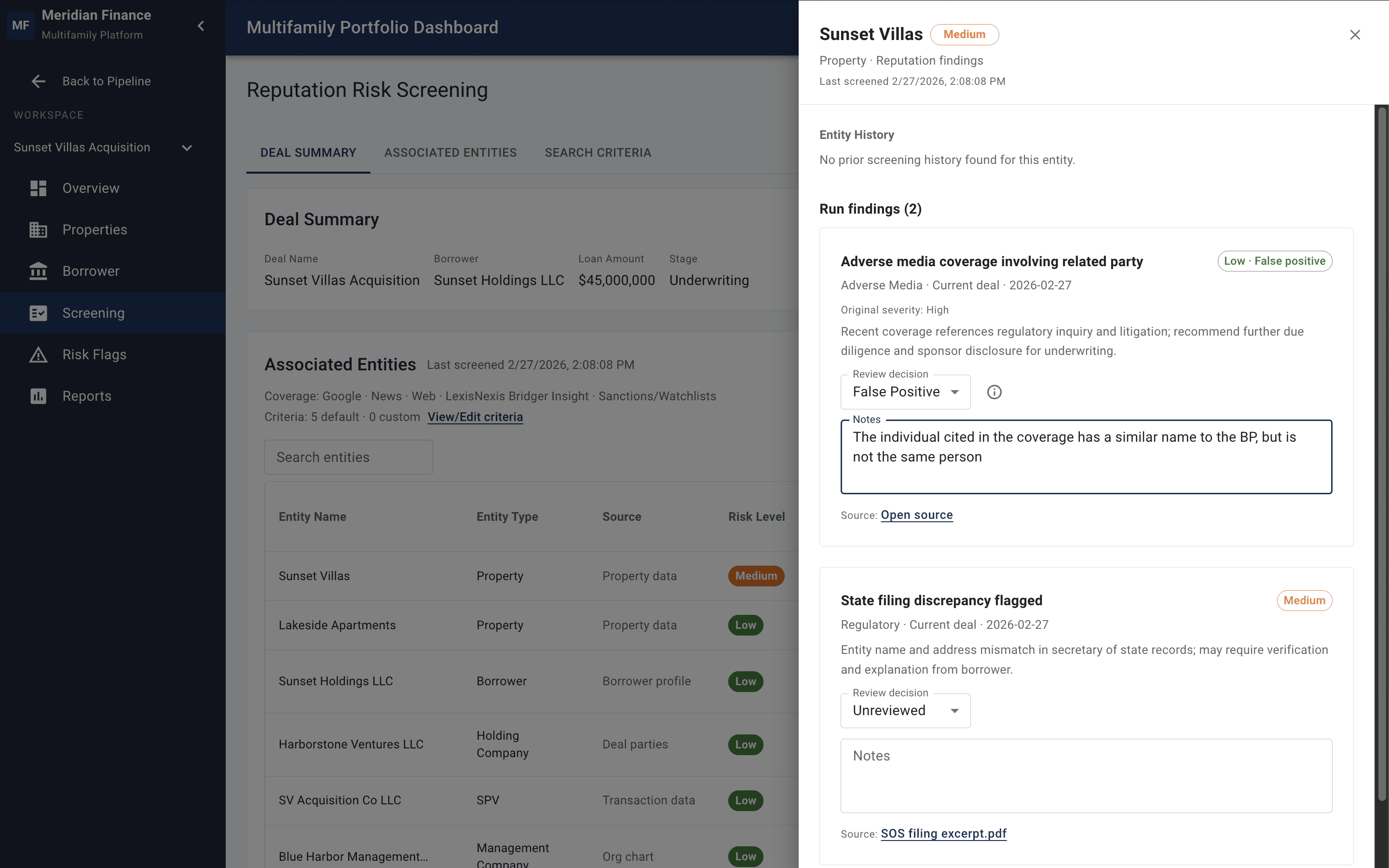
The analyst marks the finding as a false positive and annotates it to preserve context for future screening across deals.
STEP 4
Risk Recalculation
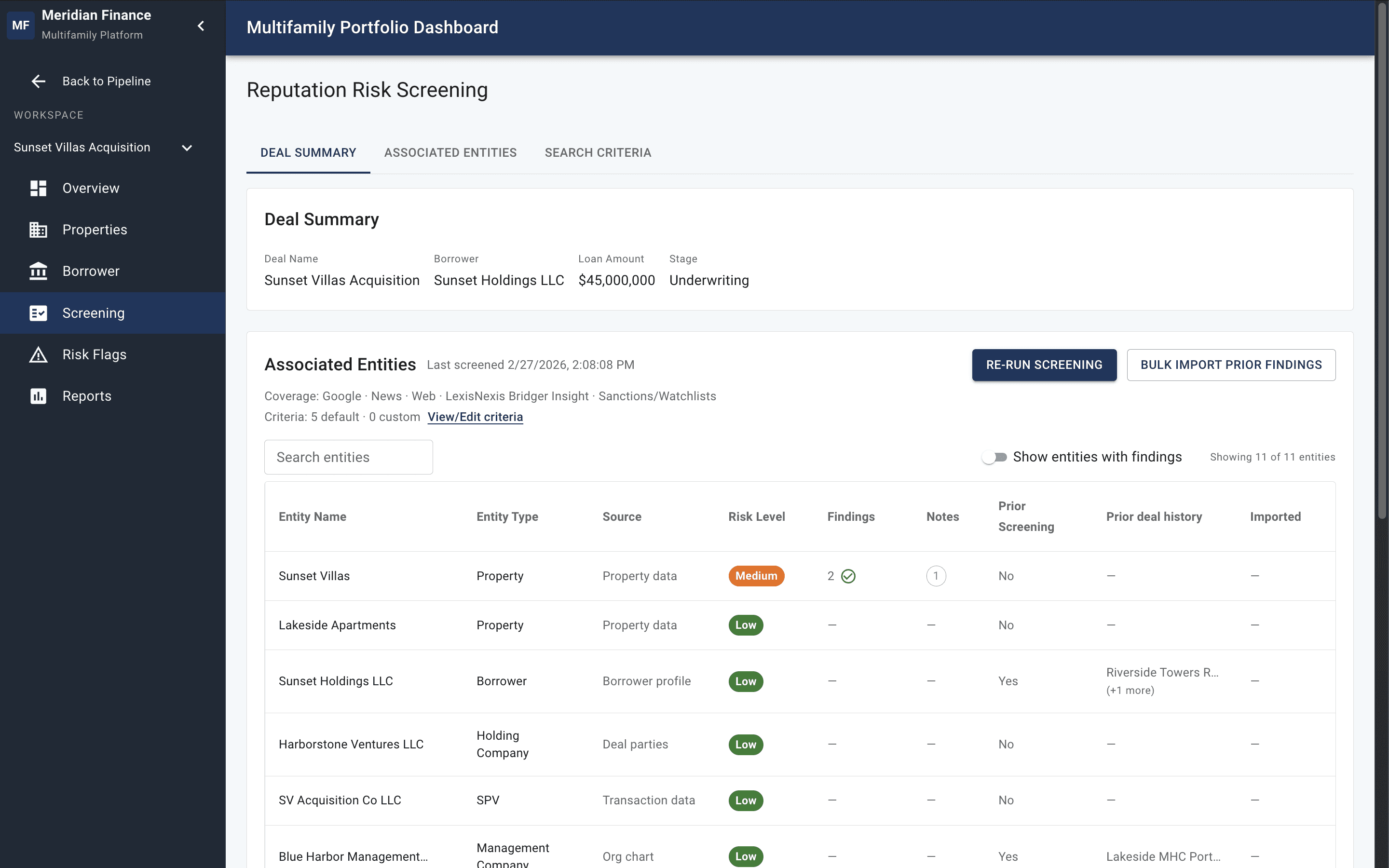
The system recalculates the entity’s risk based on remaining confirmed findings.
SYSTEM OUTCOMES
Operational Impact
The redesigned screening model reduces duplicated effort, strengthens audit defensibility, and converts screening from a deal-bound task into a reusable institutional capability.
Operational Risk Mitigation
Reduces human error in manual documentation: Automated query execution removes copy-paste workflows and fragmented record-keeping that often lead to inconsistent risk documentation.
Standardizes screening evaluation logic: A rules-based workflow replaces analyst-specific search patterns, ensuring every entity is screened using the same protocol regardless of who performs the review.
Protects institutional knowledge: Entity-level persistence prevents borrower history from being trapped in individual underwriters’ notes or local files, reducing knowledge loss during staff turnover.
Regulatory & Compliance Risk
Creates a traceable audit trail: Each risk determination is linked to source evidence and analyst annotations, enabling clear point-in-time audit reconstruction for internal or regulatory review.
Strengthens KYC defensibility: Separating automated screening execution from analyst review provides a transparent record of how high-severity findings were confirmed or dismissed.
Prevents screening gaps in complex borrower structures: System orchestration ensures that all entities within layered borrower structures are queried, reducing the risk of missed entities during manual screening.
Workflow Efficiency
Reduces repeat entity screening time: Prior findings can be imported and reviewed rather than recreated, significantly reducing effort for recurring borrowers.
Eliminates full re-screening for repeat entities: Entity-level persistence allows screening history to follow borrowers across transactions.
Replaces manual coordination with structured workflow: Multi-entity screening becomes a deterministic import-and-review process rather than repeated manual searches.
DESIGN CAPABILITIES
What This Work Demonstrates
This project reframes borrower screening as a scalable, rules-based system capability rather than a repetitive coordination task.
Enterprise workflow redesign beyond UI optimization
Rules-based state modeling in a regulated environment
Institutional memory at the entity level
Evidence-derived risk abstraction
Audit-aware interaction design
Technical implementation in React and MUI